

🖴 Hard Disk Drive (HDD): Structure, Logic, and Application
A Hard Disk Drive (HDD) is a non-volatile external storage device based on magnetic storage principles and mechanical rotation. It stores, reads, and writes data through high-speed spinning platters and movable read/write heads. Its defining characteristic is the reliance on physical motion to facilitate data interaction.🔩 Physical Structure
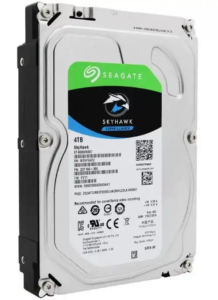
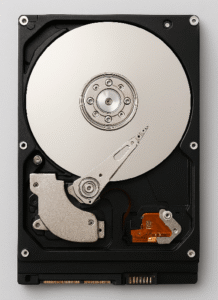
The head-platter assembly includes:
- ① Head Assembly: The most precise component. Heads hover just $0.1–0.3\mu m$ above the platter surface.
- ② Actuator Mechanism: Ensures accurate and rapid positioning of the heads over designated tracks.
- ③ Platters: High-density magnetic disks used for data storage.
- ④ Spindle Assembly: Modern drives often use Fluid Dynamic Bearing (FDB) motors for stability.
- ⑤ Preamp Circuitry: Amplifies weak signals from the heads and controls servo positioning.
🧠 Logical Structure
Tracks: Concentric circles formatted on each platter surface, numbered from the outer edge inward.
Cylinders: Comprises all tracks of the same radius across multiple platters.
Sectors: The smallest addressable unit, typically storing 512 bytes plus metadata.
📏 Capacity Calculation
$$Capacity = Heads \times Cylinders \times Sectors \times 512\ bytes$$
| Unit | Bytes (Binary) |
|---|---|
| 1KB | 1,024 |
| 1MB | 1,048,576 |
| 1GB | 1,073,741,824 |
| 1TB | 1,099,511,627,776 |
🧭 Key Features and Use Cases
✅ Advantages
- High Capacity: Single drives exceed 18TB.
- Mature Tech: Stable performance over 60 years.
- Cost Efficiency: Lower cost per GB than SSDs.
⚠ Limitations
- Slower Speed: Low random IOPS due to motion.
- Fragility: Sensitive to vibration and impact.
- Noise: Mechanical parts generate sound.
Files are stored sequentially by cylinder, head, and sector. The disk controller locates the physical address, moves the actuator, and ensures data integrity via Error Correction Codes (ECC).
Post time:2 月-13-2026